2026 World Cup Betting Boom: Over $50 Billion Expected to be Wagered Worldwide
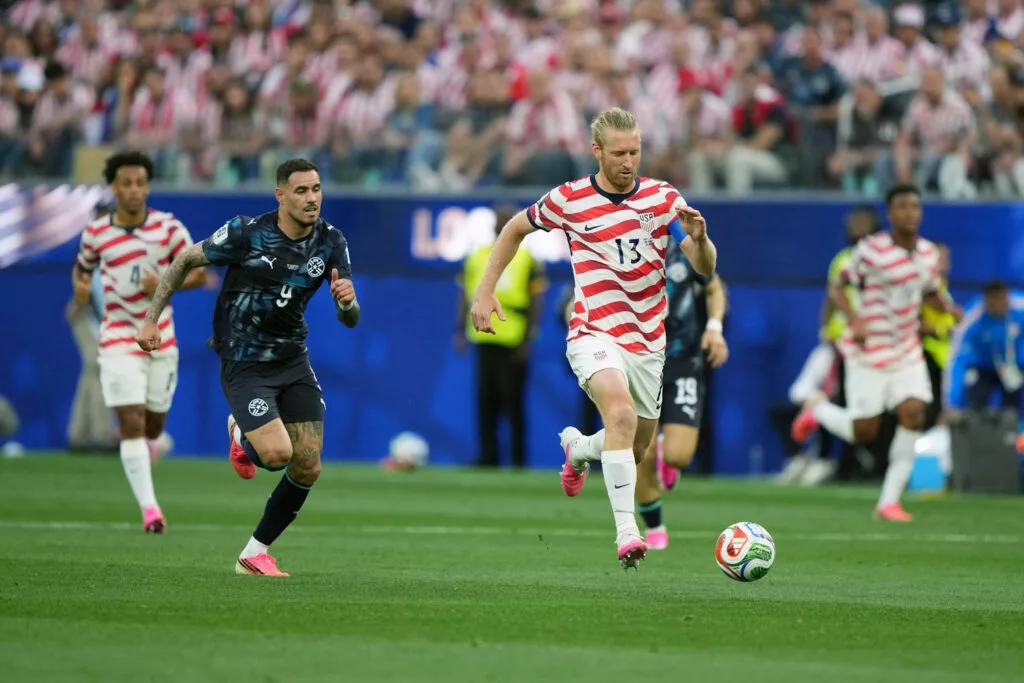
The 2026 World Cup is underway, and the United States is off to a flying start on the pitch, following its 4-1 victory against Paraguay.
U.S. sportsbook operators are also looking to get off to a fast start, and it’s incredible to imagine what a successful U.S. Men’s National Team run might look like, potentially rivaling single-event records like the Super Bowl and March Madness. Not only is the USMNT clicking on all cylinders, but the World Cup is being held on our own home soil with massive amounts of foreign tourists getting in on the action.
It is estimated that the global betting handle for the World Cup could exceed $50 billion, the most ever for a single event. Here in the U.S., sportsbooks are expected to get around $3 billion in handle, with the possibility of over $4 billion if the USMNT goes on a historic Cinderella run.
So, just how turned up will the bettors be for the World Cup? Well, that will depend on several different factors.
2026 World Cup Betting Markets
Soccer is overwhelmingly the most popular sport to watch around the world, and it’s even more prevalent in the global sports betting market.
Many of the foreign leagues, like the English Premier League, La Liga, Bundesliga, and Serie A, dominate the sports betting world, helping soccer account for nearly 35% of the betting market in recent years.
It’s also worth noting that the World Cup has moved to an expanded 48-team format, producing a total of 104 matches and offering even more betting opportunities than ever before. And you can’t forget that more jurisdictions in the United States have been added to the list of legal sports betting states, making the pool even larger.
U.S. Market for Soccer Betting
As mentioned in the open, the United States is expected to reach $3 billion in betting handle for the 2026 World Cup, with that number increasing the further the USMNT advances. According to a report from Eilers & Krejcik Gaming, the final projection is listed at $4.4 billion.
About 65% of the U.S. population has access to legal sports betting, a huge increase from 40% in 2022. Additional games, plus a much-improved USMNT squad, can really turn this into an event like March Madness, since it is a multi-day event.
The U.S. might not love soccer as much as other countries, but this is really the time when even the most casual fan screams, “GOOOOOAAAAAL!”
Global Markets for Soccer Betting
According to Macquarie analyst Chad Beynon, World Cup wagers across the globe could exceed $50 billion, far more than the $ 35+ billion spent during the 2022 competition.
It’s probably hard to fathom, but other countries do not have the same wealth of elite professional sports leagues as the U.S. Without those other options, soccer has become the go-to choice for many sports fans in different countries.
In order, England, Germany, Italy, Spain, and Brazil were all ahead of the United States in soccer betting handle. Nigeria, France, and Australia all came in behind the U.S. in soccer betting handle.
How Will Legislators and Operators Handle the 2026 World Cup?
You don’t need a travel guide to tell you how different things are in the United States compared to other countries around the world. However, you may be surprised to know that other countries are the strictest when it comes to gambling rules.
Aside from the regulatory aspects, it’s also an important time for sportsbooks. The World Cup is a tournament that only happens every four years, so the operators want to capitalize on this golden opportunity. After all, there are more games and legal markets (especially in the U.S.) at this point; these guys have to strike while the iron is hot.
United States
Each time the World Cup rolls around, we Americans have the utmost hope that this will be the year our beloved red, white, and blue finally breaks through and wins it all.
Then comes the disappointment…
Typically, the U.S. sportsbooks clean up when the home team takes the pitch. It’s not uncommon to see swaths of fair-weather money coming in on the USMNT in hopes they can pull off the miracle. From a first-hand account, there have been plenty of times I have felt a little more patriotic than usual if we were taking on a powerhouse like Germany or Belgium and came out on the losing end.
This century, the USMNT has only reached the Quarterfinals (2002), with exits in the Round of 16 in three of the last four World Cups. However, there’s plenty of optimism this summer, with Folarin Balogun and Christian Pulisic leading the way and winning Group D.
New Jersey even tried to capitalize on the World Cup as much as possible. In addition to the inflated costs of public transportation, Jersey leadership tried to impose a 10% GGR (gross gaming revenue) tax on sportsbook operators, but the bill ultimately failed to pass.
Related Articles
Canada & Mexico
While the United States is the host for World Cup matches, Canada and Mexico are also co-hosts of this North American spectacle.
Canada has legalized sports betting, but the type of sports betting it offers varies by province. For instance, in Ontario, they have a very similar platform to the U.S., with many of the major operators we’re all familiar with; Alberta will have the same in mid-July. In all other provinces, there are government-run monopoly platforms with limited markets, as some offer only single-game wagers.
Mexico has online sports betting, but it just got a lot less desirable for the sportsbooks. Now they must partner with a land-based casino to be fully operational. Also, Mexican operators were hit with a hefty bill in 2026, as the government raised the betting from 30% to 50%.
International Markets
As mentioned before, the international markets for soccer betting are as big as they get. Led by the United Kingdom, there isn’t a single hour when these people aren’t eating, breathing, or sleeping soccer. If you have ever watched an English Premier League game, you have undoubtedly seen the ads for betting operators all over the stadium, and even on the players’ jerseys.
Many countries overseas have regulatory bodies like the ones we have in the U.S., although we do see higher tax rates on operators in places like Italy and Spain.
All of these countries have taken the necessary precautions to ensure everything runs smoothly amid the higher volume of bets placed over these five weeks.
Could the 2026 World Cup Entice More U.S. States to Legalize Sports Betting?
When the final curtain closes on the 2026 World Cup, it will likely be looked back on as the one sporting event that made sports betting even more appealing to the U.S. states without it.
The massive projection (upwards of $4.4 billion) that U.S. sportsbooks will likely take in should be reason enough, but most states will continue to play hardball, or ethical overlords.
Many states with legalized sports betting are raking in millions of dollars from GGR (gross gambling revenue) taxes, and those hosting World Cup matches this summer are basking in additional tourism revenue from amenities like restaurants, hotels, and other entertainment attractions.
U.S. States Without Sports Betting: We’re Looking at You
It drives me up the wall that California and Texas (both in the Top 3 in U.S. population) still don’t have legalized sports betting. Even Florida, to some extent, is mired in a battle that heavily restricts its marketplace to a single major operator, but at least it has tried to make some inroads.
This is a new world we’re living in, where calculated risks must be taken to make more money. And Lord knows these states need it, as they keep coming back to the citizens for more money every chance they get.
I hope that the USMNT is the unifying force that gets these states without sports betting to realize they’re missing out on the party. If the boys can come through in the clutch and win the 2026 World Cup, it will be a huge miss not capitalizing while plenty of other states are swimming in profits.
Read More
